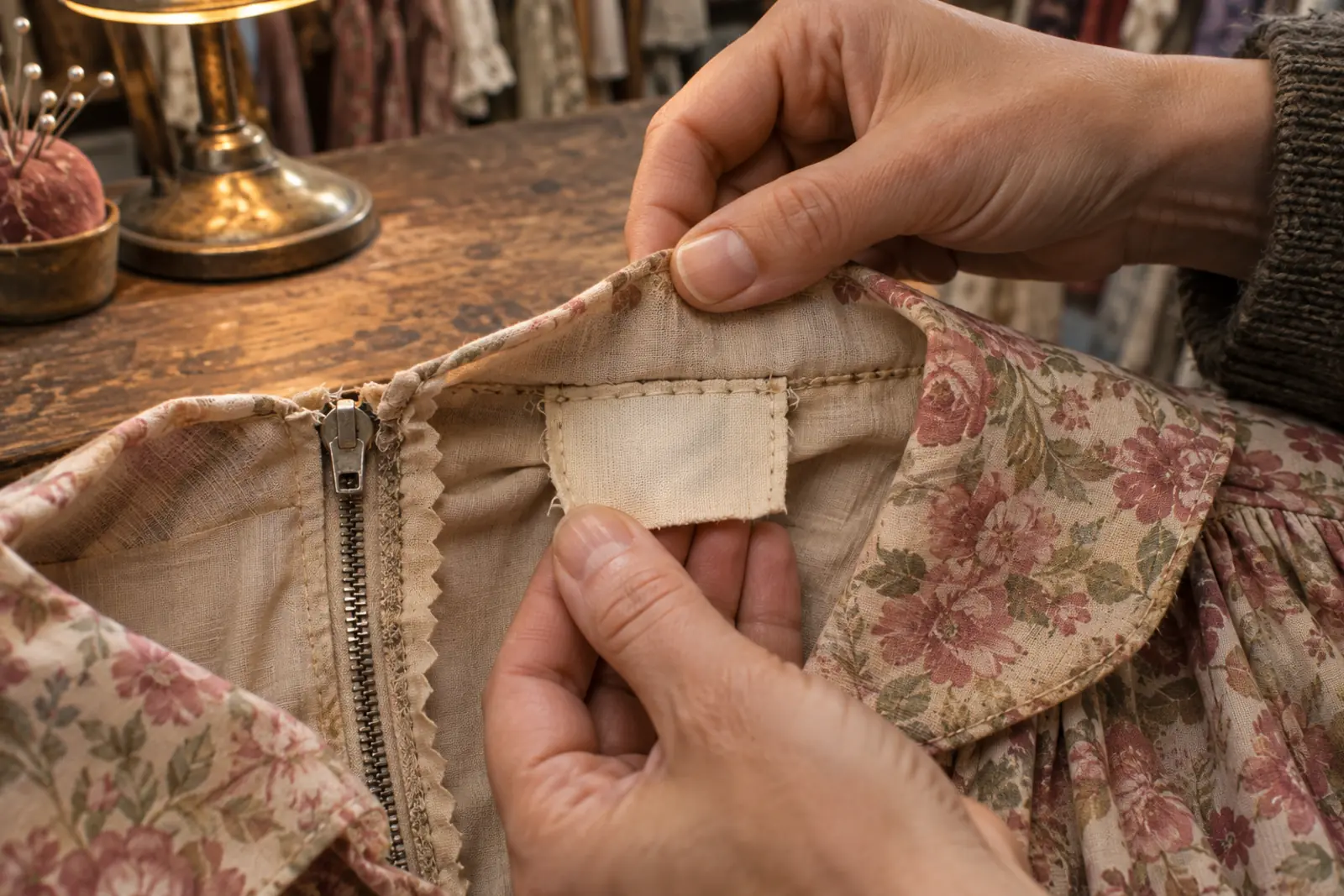
To date vintage clothing, read every sewn-in label and sort the clues into three groups: labels that set an earliest possible date (a care label, a union label with “AFL-CIO” wording, a “Made in the U.S.A.” line on a union tag), labels that only identify a business (the maker’s name and the RN number), and physical evidence from the zipper, seams and fabric. Where the groups agree, you have a date range. An RN number is not a date code, and no single label settles the question. Cornell’s Kheel Center says its union-label project helps date clothing to within a decade.
Start with the labels, then test the story
Look inside the neckline, side seams, waistband, pockets and lining. Read every label before drawing a conclusion. A maker’s label, fiber label, care label and union tag serve different purposes, and they may offer different kinds of evidence. Photograph their wording and stitching so you can compare them with references later.
Check whether each label appears original to the garment. Replacement linings, alterations and repairs can separate a label from its original setting; the guide to tailoring and alterations covers what alterations involve. An old tag sewn into newer clothing remains an old tag. For the broader inspection, including condition and fit, see the guide to judging vintage clothing before buying.
How to identify vintage clothing labels: a quick order of work
- Find every label and note its position, material, stitching and wording.
- Note the fiber, origin and care wording. A permanent care label suggests a later period, though a missing one proves little.
- Write down any RN number and look up the business that holds it.
- Compare any union tag with documented label designs.
- Check zippers, seams, buttons and fabric against the labels, then state the result as a range.
The main label: identity before age
Maker, fiber content and country of origin
The main label often identifies the business associated with the garment. Its lettering, material and wording can provide leads, but visual style alone is weak evidence: lettering can be revived, and a business may retain an older label design.
The Federal Trade Commission’s Textile and Wool Acts guidance explains the general requirements for covered products: fiber content, country of origin, and the maker’s name or registered identification number, known as an RN. Read the labels together; the largest label may contain the least useful information. Exceptions and coverage matter, so avoid assuming that every garment must carry an identical set of disclosures.
An RN identifies a business
An RN is an optional business identifier, not a manufacturing year. Do not read its digits as a date code. Even identifying the associated business does not establish when a particular garment was cut, sewn or sold. Use the FTC’s textile and wool labeling guidance to understand what the disclosures mean. Verify current labeling requirements with the FTC.
How to do an RN number lookup
The FTC runs a public RN database on its website. Search by RN number, company name or legal business name. When searching by number, enter only the digits, without the “RN” prefix. The result names the business that holds the number, which gives you a maker to research.
- Who holds RNs. According to the FTC, it issues RNs to U.S. firms that manufacture, import, market, distribute or otherwise handle textile, wool or fur products, and a business outside the U.S. cannot get one. A company has one RN.
- A missing RN says little. The FTC says an RN is not required to do business in the U.S.; a company may print its full name instead.
- Database limits. The FTC states that results are only as accurate and current as the information submitters provide. A number that returns no match, or a different business than the label shows, may reflect cancelled or outdated records, so treat the lookup as a lead.
What the lookup can do for dating: once you know the business, its own history (when it operated, when it changed names, what it made) can bracket the garment. The number itself cannot.
Care labels: useful evidence with limits
The FTC issued its Care Labeling Rule on December 16, 1971. A permanent care label consistent with that requirement therefore suggests manufacture after its introduction, but care instructions could appear voluntarily earlier. The issue date is a reference point, not an automatic dividing line between old and new.
According to the FTC, care symbols were allowed in place of words from July 1997. Symbols alone still need context: consider where the garment was intended for sale, whether words accompany them, and whether the label looks original. Do not assign an American regulatory timeline to every imported or overseas-market piece.
A missing care label proves little. It may have been clipped away, removed during alterations or lost with a replaced lining. Look for cut edges and stitch marks, but remember that even those cannot recover the missing wording. Verify the current care-label rules with the FTC.
Vintage clothing union label dating
Union tags can help place a garment within American garment-making history. According to Cornell’s Kheel Center, the International Ladies’ Garment Workers’ Union, or ILGWU, formed and adopted an official label at its first meeting on June 3, 1900. That does not mean labels immediately appeared throughout the trade.
The Kheel Center records that use spread slowly until the coat-and-suit industry adopted the label in the 1930s, and that a Union Label Department was established in 1958. It also records the ILGWU’s merger with the Amalgamated Clothing and Textile Workers Union in 1995 to form UNITE. These milestones provide context; they do not individually date a garment.
Design changes that narrow the range
The Kheel Center’s union label timeline records design changes that work as floors and ceilings. Use them as a range, not a date.
- A Blue Eagle (NRA) label appeared in 1933, and a Consumer Protection label followed in 1935 and was used until at least 1959.
- Labels reading “AFL-CIO” rather than “AFL” date from 1955 or later.
- The ILGWU Union Label launched in January 1959, and in 1963 the design emphasized the words “union made.”
- A red, white and blue label with a “Made in the U.S.A.” line dates from 1974 or later.
Compare wording, lettering and symbols against the Kheel Center’s ILGWU timeline and label project. A union label is a clue to American production and a rough era, not proof of an exact origin or date. Its absence proves nothing. The Lower East Side garment-trade history guide explains the neighborhood context behind the sewing.
What each clue can actually tell you
| Clue | What it can tell you | How reliable |
|---|---|---|
| Main label | Business identity and possible design period | Useful with documented comparisons; appearance alone is weak |
| Fiber and origin labels | Declared composition and manufacturing origin | Useful context if original; limited for dating |
| Care label | Possible regulatory and market context | Helpful supporting evidence; absence is inconclusive |
| Union tag | A possible production context and approximate era | Stronger when matched to documented examples |
| Construction and fabric | Whether the physical garment supports the label evidence | Best considered together; repairs can confuse the picture |
Construction, fabric and sizing
Turn the garment inside out
Zipper types, seam finishes, buttons, linings and hand finishing changed over the decades, but techniques overlapped. Reference collections can help with comparisons; there is no universal zipper calendar. A replaced fastening may be much younger than the cloth around it.
- Compare zipper stitching with the surrounding seams for signs of replacement.
- Inspect seam allowances and lining attachments for alterations.
- Check whether buttons match in material, wear and attachment.
- Look for hand finishing without treating it as proof of age or quality.
Let fabric support the estimate
Compare the stated fiber content with the cloth’s texture, weight, weave and drape. Blends and finishes complicate identification by touch. Fabric may also predate the garment made from it. Avoid destructive experiments on something you do not own; uncertainty is preferable to a damaged sleeve.
Measure the garment
Older sizes differ from modern ones, and sizing also varies between makers and garment types. Measure instead of translating the printed size into a supposed modern equivalent. Compare the measurements with clothing that fits, allowing for cut and ease. For present-day production questions, the guide to locally made clothing labels explains what to ask about manufacturing claims. If you are buying in a thrift or consignment shop, the thrift versus consignment guide explains how those shops work, which helps when judging what a seller can tell you about a piece’s history.
Frequently Asked Questions
Can you date vintage clothing by RN number?
Not directly. An RN identifies the business, not the year, so the digits are not a date code. Look the number up in the FTC’s RN database to learn which company held it, then use that company’s history, together with the other labels, to bracket the period.
How do I look up an RN number?
Use the FTC’s RN database search and enter only the digits, without “RN” in front. Results depend on the information the business submitted, so a missing or mismatched result is a lead to check rather than proof of anything about the garment.
Can a label give an exact manufacturing date?
Usually it supports an approximate period. Labels could remain in use, and garments could be altered or relabeled. A defensible estimate brings the label, fabric and construction into agreement, while acknowledging any evidence that points elsewhere.
Does no care label mean a garment is old?
No. A care label may have been removed because it scratched, disappeared with a lining, or been cut out during alterations. Absence is a gap in the evidence. It cannot establish age without other clues.
Does a union tag prove American manufacture?
It is supporting evidence, especially when its design matches documented examples and its stitching appears original. It is not independent proof of the garment’s complete production history. Examine the country-of-origin information and the garment itself as well.
What if the labels and construction disagree?
Keep the estimate broad and investigate the mismatch. A replacement zipper, transferred label or substantial alteration may explain it. Ask what the seller actually knows and what is inferred. An uncertain date should remain uncertain on the description.