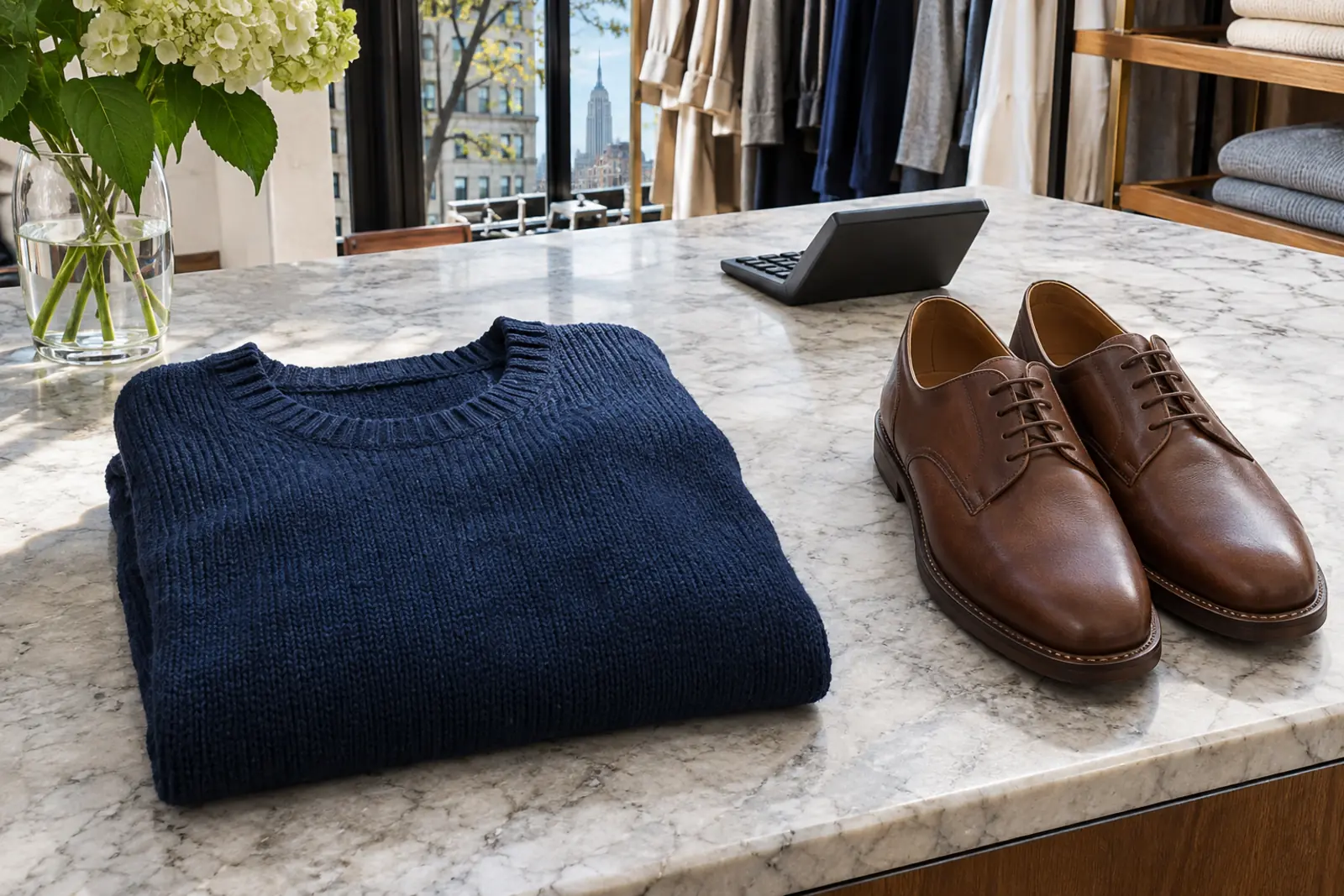
In New York City, clothing and footwear that sell for less than $110 per item or pair pay no New York State or New York City sales tax. At $110 or more, the full combined rate of 8.875% applies to the whole price of that item. These rules come from the NYC Department of Finance’s sales-tax guidance and the New York State Tax Department’s clothing exemption bulletin. A garment priced at exactly $110.00 is taxed, because the state test is “less than $110.”
NYC clothing tax: what the exemption covers
The exemption concerns qualifying clothing and footwear worn by humans, not everything sold beside them. Start with the item, then its selling price. A shirt and a watch can appear on the same receipt and receive different tax treatment. The fact that both are things a person wears does not settle the question.
The combined rate
The NYC Department of Finance lists the taxable rate as 4.5% city tax, 4% state tax and a 0.375% Metropolitan Commuter Transportation District (MCTD) surcharge, totaling 8.875%. For qualifying clothing and footwear under $110, all three parts are exempt in New York City. The state’s Publication 718-C, edition dated February 2025, lists New York City among the jurisdictions where eligible items under $110 are fully exempt from state and local sales tax, including the MCTD tax.
The city’s exemption is not new. According to the state’s 2006 memo TSB-M-06(6)S, New York City’s year-round exemption took effect on September 1, 2005 and was extended to the MCTD tax from April 1, 2006. Check the NYC Department of Finance’s sales-tax guidance for the city’s explanation, and verify current rates with the New York State Tax Department before relying on them for a disputed purchase. This guide provides general information, not legal or tax advice.
The test is per item, not per receipt
A bagful of qualifying garments does not become taxable simply because the receipt total grows. The state bulletin’s own example is two shirts, two pairs of pants and a dress totaling $190, all exempt because each piece costs less than $110. Each item or pair gets its own test. Conversely, placing an expensive garment beside exempt purchases does not spread its price across the bag.
The following hypothetical prices illustrate the item-by-item rule. The taxable rate comes from the NYC Department of Finance guidance cited above.
| Qualifying garment | Illustrative selling price | NYC sales-tax treatment |
|---|---|---|
| Shirt | $90 | Exempt |
| Pair of pants | $109 | Exempt |
| Coat | $120 | Taxed at 8.875% on the full item price |
The coat’s entire selling price is taxable, rather than just the portion above the threshold. The shirt and pants remain exempt. Ask for an itemized receipt so the selling price and tax treatment can be checked separately. A single unexplained tax line makes that harder than necessary.
Is there sales tax on shoes in NYC?
Footwear follows the same rule as clothing: a pair that sells for less than $110 is exempt from state and city sales tax, and a pair at $110 or more is taxed at 8.875% on the full price. The test applies to the pair, not to each shoe. Sneakers, boots, slippers and dance, golf or cleated shoes are on the Tax Department’s exempt list, and so are shoe laces, insoles and shoe inserts.
Skates are the exception. Ice skates and roller skates are treated as equipment and stay taxable at any price.
What stays taxable regardless of price
The New York State Tax Department distinguishes ordinary clothing from accessories, rentals and equipment. Its 2006 memo says most accessories are not clothing and are taxable. Items on its taxable list include:
- Handbags, purses, wallets and key cases.
- Umbrellas and non-prescription sunglasses.
- Jewelry, watches and watch bands.
- Wigs and most hair accessories, such as barrettes, bobby pins, hair clips and headbands (sweatbands are exempt).
- Costumes, party costumes and rented formal wear.
- Equipment such as hard hats, bicycle and motorcycle helmets, protective sport masks and pads, and baseball or hockey mitts.
- Ice skates and roller skates.
- Doll and pet clothes and footwear.
Some accessories are exempt. The same memo lists belts, suspenders, belt buckles, handkerchiefs, head scarves, scarves, ties and other neckwear, gloves, hats and hosiery as exempt when they cost less than $110. A low price does not turn the taxable categories into exempt clothing, and their location in a clothing store does not either. For an uncertain item, check the Tax Department’s clothing and footwear exemption guidance, which points to a more detailed classification list. The department describes its lists as a guide that is not all-inclusive.
Gift sets and bundles
If exempt clothing is sold with taxable merchandise as a single unit, the full price is taxed unless the clothing’s price is separately stated. The memo’s example is a boxed set of a dress shirt, cufflinks and a tie tack sold for one $50 price: the whole box is taxable because the cufflinks and tie tack are taxable. A bundle of shirt plus watch priced as one item behaves the same way, so look for separate prices on the receipt.
Sample sales, vintage and secondhand clothing
The Tax Department’s test is the item’s type and its selling price, so the price actually charged at a sample sale is what counts, not the figure on a retail tag. The guide to sample sales explains the buying conditions worth checking before paying. A discounted garment can still be taxable, and a final-sale notice answers a different question from a tax line. Returns and receipts are covered in the guide to store refund rules in New York City.
The 2006 memo says antique clothing and footwear are exempt if bought to be worn, and taxable if bought as a collector’s item. Ordinary vintage and secondhand garments sold under $110 are the usual case. The thrift, consignment and resale guide explains the selling arrangements, and the guide to vintage shopping on the Lower East Side covers how to judge pieces. “Used” describes condition, not tax treatment. Verify any unusual piece, such as a museum-grade or collectible item, with the New York State Tax Department.
Discounts, delivery and alterations
Which discounts affect the test?
According to the Tax Department’s memo TSB-M-06(6)S, a store coupon for which the store receives no reimbursement lowers the selling price used for the $110 test. A manufacturer’s coupon does not. A coupon’s treatment matters when the resulting selling price is near the boundary: a $115 jacket with a $10 store coupon is tested at $105, while the same jacket with a $10 manufacturer’s coupon is still tested at $115.
Ask how a discount has been applied before paying. Keep the receipt and discount terms if the calculation looks wrong.
Delivery is a separate question
Reasonable, separately stated delivery, shipping and handling charges by the vendor are not counted when deciding whether an item is under $110. The memo’s example: clothing priced at $95 with a $20 delivery charge qualifies for exemption, and so does the delivery charge. Delivery charges on an item that costs $110 or more remain taxable. Ask for delivery to appear as its own line on the receipt; a combined charge makes the exemption harder to check.
Check tailoring and monogramming charges separately
If the seller adds an alteration charge for clothing it sells, the memo says that charge counts toward the $110 limit unless the seller states a reasonable alteration charge separately on the receipt. Monogramming done before the sale and sold with the garment is exempt if the item stays under $110, but monogramming or logo work billed separately is taxable. The memo does not settle whether a tailor’s stand-alone service is taxable, so verify that with the New York State Tax Department.
The tailoring and alterations guide covers arranging the work. Prices vary; ask for a written quote that identifies the work, garment charges and any tax.
Visitors and checkout checks
Visitors should not build a shopping budget around recovering sales tax later. The exemption is applied at checkout, so check the item’s treatment before paying and ask the Tax Department about any claimed visitor-specific arrangement. For where the boutiques, vintage shops and sample sales actually are, see the Lower East Side shopping guide.
- Check that the receipt identifies each garment or pair.
- Look for the actual selling price after applicable store coupons.
- Ask why an apparently qualifying item has been taxed.
- Check bags, wallets, umbrellas and jewelry separately; they are taxable at any price.
- Keep the receipt while seeking an explanation.
Frequently Asked Questions
Is clothing taxed in New York?
Clothing and footwear under $110 per item or pair are exempt from New York State and New York City sales tax. At $110 or more, the full 8.875% combined NYC rate applies to the item’s whole price. Accessories such as handbags, wallets and jewelry are taxed at any price.
Is a $110 item taxed?
Yes. The exemption applies only to items sold for less than $110, and the state’s rate publication lists items sold for $110 or more as ineligible. An item at $109.99 is exempt; at $110.00 the whole price is taxed.
Does a large receipt total cancel the exemption?
No. Qualifying garments are assessed individually, so adding exempt items to the same receipt does not make them taxable. Check each item’s selling price and classification rather than using the amount paid for the whole purchase.
Is only the amount above the threshold taxed?
No. When qualifying clothing reaches the taxable threshold, tax applies to its full selling price. The exemption is not a deduction from an otherwise taxable garment. Ask for an itemized receipt if the calculation is unclear.
Are handbags and accessories taxed in NYC?
Mostly yes. The Tax Department’s memo lists handbags, purses, wallets, umbrellas, watches, jewelry and non-prescription sunglasses as taxable at any price. Belts, scarves, ties, gloves and hats are exempt when they cost less than $110.
Can vintage clothing qualify?
Yes, in the usual case. The Tax Department treats antique clothing bought to be worn as exempt, and antique pieces bought as collector’s items as taxable. Ordinary used garments sold under $110 are exempt; verify unusual or collectible items with the Department.
Does delivery change whether a garment qualifies?
A separately stated, reasonable delivery charge is excluded from the price used for the $110 test. If the item is exempt, the delivery charge is exempt too; if the item costs $110 or more, the delivery charge is taxed.