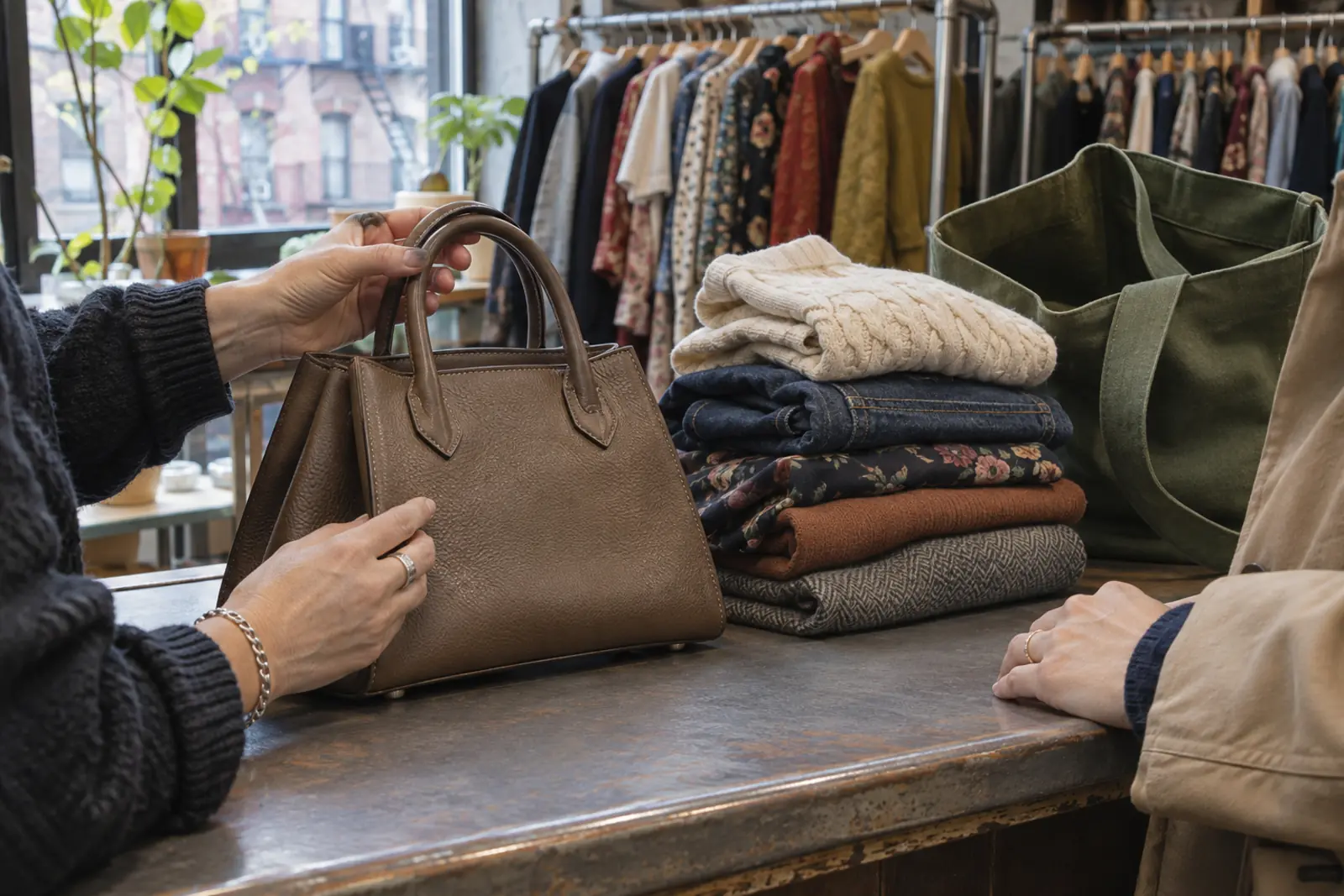
The difference between thrift and consignment comes down to who owns the clothes and who gets paid. A thrift store generally sells donated goods and keeps the proceeds; the donor is not paid. A consignment shop sells clothes on behalf of the person who brought them in, and that person receives a share only after the item sells. Resale shops that buy outright pay cash up front. In New York the labels overlap, so the useful questions are who owns the garment, when the seller gets paid and what the buyer can return.
Consignment vs thrift: the short version
- Thrift: stock comes from donations, the operator sets prices, and the donor is not paid when something sells.
- Consignment: the owner leaves clothing with a shop; payment follows a completed sale, under terms the shop sets in an agreement.
- Resale buy-out: the shop pays the seller an agreed amount at the counter and then owns the item.
- Vintage and sample sales: categories defined by era or by the source of the stock, not by how the seller is paid.
Thrift operations may support nonprofits or be run by resellers, and a single shop can mix models, for example buying some pieces outright and taking others on consignment. Treat the sign over the door as a starting point and ask how the shop actually works.
What each model means
Thrift: donated goods entering another wardrobe
A thrift operation generally receives donated clothing and sets its own selling prices. A donation does not normally earn the donor a share when something sells. Do not assume that every rack of donated goods belongs to a nonprofit, or that every secondhand purchase supports a charitable purpose. Ask how the operation works if that distinction matters to the purchase.
Consignment: payment depends on a sale
With consignment, the owner hands over clothing for someone else to sell. Payment follows a completed sale, subject to the agreement. The shop sets its acceptance standards, selling period, pricing arrangements and payment terms. Acceptance is not a promise that the item will sell. Read what the agreement says about markdowns, fees, loss and collecting unsold clothing.
Because the seller waits for a sale, consignment tends to suit pieces a shop can price well and display for weeks, such as clean, current or distinctive items, while a buy-out suits a seller who wants money immediately and accepts a lower, fixed offer. The split, the selling period and the payout schedule differ from shop to shop, so compare them in writing rather than relying on a general figure.
Resale, vintage and sample sales
A resale buy-out transfers the item to the buyer for an agreed payment up front. The later selling price belongs to that business decision. Vintage describes selection by era rather than a payment arrangement; a vintage dealer might purchase stock outright or accept it on consignment. The guide to judging vintage clothing explains what to examine beyond an appealing silhouette, and how to date vintage clothing covers the label clues that separate genuine age from a retro look.
Sample sales are a different supply stream, usually involving samples or other stock rather than household donations. Condition, sizing and selling terms need attention there too. Read how sample sales work before treating the label as a guarantee of value.
Compare the transaction before comparing the racks
| Model | Who owns the item | How pricing works | Returns | How you sell |
|---|---|---|---|---|
| Thrift | The recipient generally owns donated stock. | The operator sets prices. | Check the posted policy. | Donate; payment is not normally offered. |
| Consignment | The consignor generally retains ownership until sale, subject to the agreement. | The agreement governs pricing and markdowns. | Check the buyer policy and seller agreement. | Submit clothing for acceptance and receive a share after sale. |
| Resale buy-out | The business owns the item after buying it. | The business sets its resale price. | Check the posted policy. | Accept an offer for payment up front. |
| Vintage dealer | Depends on how the dealer acquired it. | The dealer assesses era, condition and other selling factors. | Check the posted policy. | Ask whether the dealer buys outright or consigns. |
| Sample sale | The stock owner or seller, depending on the arrangement. | The seller sets sale prices. | Check the policy before paying. | Generally a stock-selling channel, rather than household clothing intake. |
NYC consignment stores: what to expect and ask
New York has consignment and resale shops across many neighborhoods, from the Lower East Side and Nolita to other boroughs, and each sets its own intake rules. Some take walk-ins, while others may ask for an appointment or photos first, and intake can depend on the season. Check the shop's current seller instructions before travelling with a bag. For a wider look at the shop types around Orchard Street, see the Lower East Side shopping guide.
Before leaving anything, put these questions to the shop:
- Is this consignment, a buy-out or either, depending on the piece?
- What share does the seller receive, and are there deductions or fees?
- How long is the selling period, and who decides markdowns?
- When and how is payment made, and is it cash, check or store credit?
- What happens to unsold items, and by what date must the owner collect them?
- Does the shop keep a written, itemized record of what you left?
As a buyer in a consignment shop you are buying from the shop, so its posted refund policy is the one to read.
How to offer clothes for sale
Start with the intake rules. A shop may want particular categories, conditions or seasons, and those preferences can change. Ask before carrying a heavy bag across the neighborhood. Previous retail cost does not establish what someone will offer now. Neither does sentimental value, which tends to travel poorly on a hanger.
- Present clothing clean, dry and pressed where the fabric permits. Empty pockets and disclose repairs or damage.
- Ask about seasonal timing and whether an appointment or advance description is required.
- For consignment, ask about the seller’s share, deductions, markdown authority and payment arrangements.
- Confirm the contract period and what happens if an item remains unsold.
- Get the terms in writing and retain an itemized record of accepted garments.
Read collection deadlines carefully. Ask whether unsold items are returned, donated or handled another way, and whether the owner must request their return. For a buy-out, confirm the offer before handing over ownership. A refusal is simply a refusal; it need not become a verdict on the wardrobe.
What to check before buying
Inspect the actual garment. Look along seams, underarms, collars, cuffs and hems, then examine closures and the lining. Check for thinning fabric, holes, loose stitching, stains and repairs. Turn the piece inside out when permitted. A neat exterior can conceal a lining that has finished its working life.
Smell matters. Persistent odor may remain after cleaning, and its removal should not be assumed. Read fiber and care tags, while recognizing that tags may be missing or incomplete. Check whether the garment can be cleaned in a way that suits both its materials and its construction.
Try it on where allowed. Move, sit and check that closures lie comfortably. A size tag is a starting point. If the purchase depends on alterations, ask a tailor about feasibility and obtain a written quote before committing; prices vary. The tailoring and alterations guide lists what to ask and what is usually possible. Extra fabric and seam placement can matter more than optimism.
Hygiene without guesswork
Do not assume a garment has been cleaned because it looks tidy or carries a tag. Ask what preparation occurred. Keep purchases awaiting inspection and cleaning separate from the wardrobe, follow appropriate care instructions and avoid buying something whose condition raises unresolved concerns. Cleaning cannot be counted on to reverse every stain, odor or material problem.
Tax and refunds still need checking
According to NYC Department of Finance guidance, clothing and footwear under $110 per item or pair are exempt from NYC and New York State sales tax. That was the NYC Department of Finance wording in November 2026, and local elections can change only on March 1 of a year, so verify the current rule with the Department. The guide to the clothing sales-tax exemption explains the per-item test; secondhand status alone does not settle the tax question.
NYC DCWP says stores must post their refund policies, and stores offering no refunds must post “No Refunds.” Stores set their own policies, and the conditions must be posted where customers can easily read them, such as at the register, point of sale or entrance. According to the same DCWP shopping-tips page, if no policy is posted, a customer can return an unused item within 30 days and the business must let the customer choose cash or credit. Check the policy before paying, including whether it offers money back, exchange or credit. Read the guide to store refund rules and verify current requirements with NYC DCWP. This is general information, not legal or tax advice.
When clothing does not sell
Reconsider condition before trying another intake counter. Wearable clothing may suit donation; damaged textiles need an appropriate recycling option. DSNY lists clothing donation and recycling options, and DonateNYC lists organizations and accepted materials; verify current acceptance rules with those sources. The page on donating used clothes in NYC covers official options and how to prepare a donation.
Frequently Asked Questions
What is the difference between thrift and consignment?
Thrift stores generally sell donated goods and keep the proceeds, so the donor is not paid. Consignment shops sell clothing for its owner and pay the owner a share after the item sells, under the shop's agreement. The practical differences are who owns the garment while it is on the rack and when, or whether, the seller gets paid.
Does thrift always mean nonprofit?
No. Donated goods can be sold through different operating arrangements, including resellers. Ask who runs the operation and where proceeds go if charitable purpose matters to the decision. The word thrift alone does not explain the business model.
Is consignment payment guaranteed?
No. Payment generally depends on the garment selling under the agreed terms. Before leaving it, establish how pricing, deductions, markdowns and payment work. Also confirm the selling period and the procedure for recovering anything that remains unsold.
Can you return something bought at a consignment shop in NYC?
It depends on the shop's posted policy. NYC DCWP requires stores to post their refund conditions, and a store that offers no refunds must post “No Refunds.” Where no policy is posted, a customer can return an unused item within 30 days, so read the sign before paying.
Can a vintage garment be altered?
Sometimes. Fabric condition, construction, available seam allowance and earlier alterations all affect the possibilities. Ask a tailor to assess the actual piece before buying when fit depends on changes. Obtain a written quote; prices vary, and an alteration may not be feasible.
Should rejected clothing go straight to donation?
Only after checking its condition and the recipient’s acceptance rules. Rejection for seasonal or stock reasons does not mean a garment is unusable. Clothing with damage may need textile recycling instead. Check current donation and recycling options with DSNY and DonateNYC.