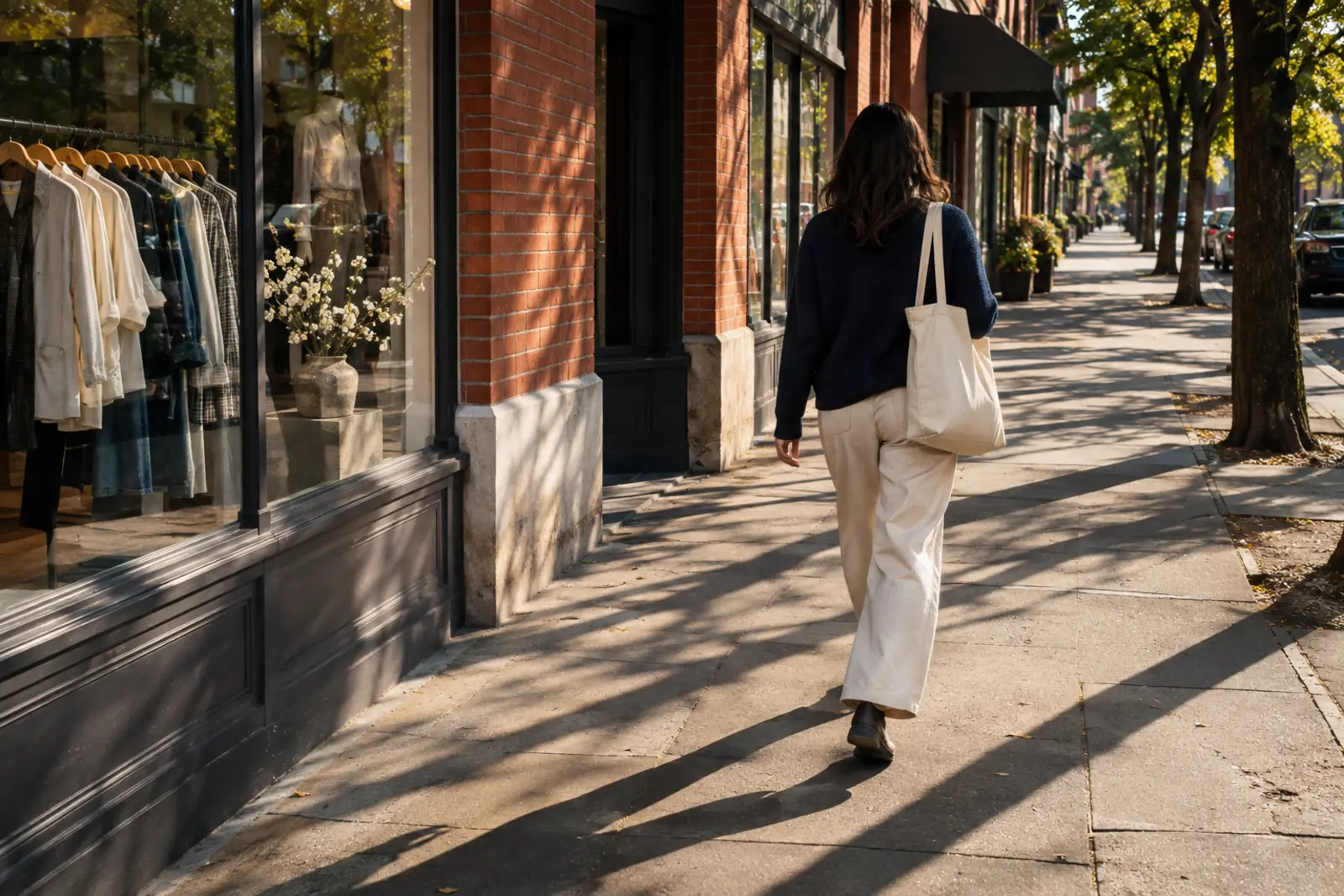
This self-guided Lower East Side walking tour starts at the Delancey St-Essex St subway station, goes north on Orchard Street to Houston Street, west to Elizabeth Street, south to Prince Street, west to Mulberry Street, and south across Spring Street to finish near Kenmare Street. Allow about three to four hours with stops, this guide’s own estimate rather than a measured walking time. The order moves from the Lower East Side’s garment-trade streets into Nolita’s smaller retail blocks.
Before setting out
This is a route through shopping streets, not a promise that particular doors will be open. For what the area’s shops are like, use the Lower East Side shopping guide; this page only covers the order of the streets. Leave space in the day for trying things on and reading labels.
Getting there: where the walk starts and ends
The Delancey Street/Essex Street station combines two sets of platforms. According to the station’s Wikipedia entry, the F and J stop at all times, the M stops at all times except late nights, and the Z stops only at rush hour in the peak direction. The same entry says elevators are planned for the station, so anyone who needs step-free access should check the MTA’s current station information before choosing this start.
For an early exit at Spring Street, the 6 train stops at Spring Street and Lafayette Street, where all four station entrances are located, according to Wikipedia’s entry for that station. Service patterns change, so confirm both stations with the MTA before leaving.
Choose the day, then check the weather
A weekday can suit a deliberate walk, though individual businesses set their own schedules. On weekends, allow room for other pedestrians and slower browsing. Orchard Street has historically been a Sunday pedestrian street between Delancey and Houston; Wikipedia’s Orchard Street entry describes that stretch as closed to vehicles on Sundays and many other days, with stores setting out tables and racks. That history does not establish what will happen on the day of this walk. Verify with the Lower East Side Business Improvement District before planning around street activity.
Check the forecast and wear comfortable shoes. Rain makes repeated trips between pavement and fitting room less appealing; heat makes a loaded bag feel ambitious. Carry a layer that comes off easily.
If the day also includes a sale, read the sample-sale guide before fixing the route. A sale’s location, entry arrangements and queue may require a separate trip. Treat that as a scheduling decision rather than assuming every fashion errand belongs along this walk.
The route, street by street
Orchard Street runs from Division Street in the south to East Houston Street in the north, about eight blocks, and is one-way northbound for traffic, per Wikipedia. Walking north along it therefore follows the direction of the cars. Nolita, where the second half of the walk goes, is bounded roughly by Houston Street to the north, the Bowery to the east, Broome Street to the south and Lafayette Street to the west, according to the same source. The name is short for “Northern Little Italy.”
- Delancey St-Essex St station to Orchard Street. At street level, orient yourself toward Delancey Street and walk west to Orchard. Turn north. This opening stretch establishes the contrast between a broad traffic street and the narrower blocks ahead. Settle bags and check your direction before becoming absorbed in windows.
- Orchard Street across Rivington and Stanton Streets. Continue north, crossing Rivington before Stanton. Look at the relationship between ground-floor commercial spaces and the buildings above them: entrances, upper windows, narrow frontages and changes in building width. These are useful clues to the neighborhood’s mixed residential and commercial fabric, though a façade alone cannot tell a building’s full history. The garment trade history timeline explains why this street became a clothing street.
- Orchard Street to Houston Street. Keep going north to Houston. This completes the Orchard section before the route changes direction. Use the crossing signals and take the crossing as its own task; Houston is a poor place to inspect a newly purchased seam. Once across, turn west along Houston toward Elizabeth Street.
- Houston Street to Elizabeth Street, then south to Prince Street. Turn south onto Elizabeth and continue across Prince. Here, compare the scale of the side street with Houston behind you. Narrower frontages make windows easy to examine on foot, but leave doorways clear when stopping. This leg introduces Nolita without doubling back through the Orchard blocks.
- Prince Street west to Mulberry Street. Return to the Prince intersection if you have wandered farther down Elizabeth, then turn west along Prince, crossing Mott Street to reach Mulberry. Prince, Mulberry and Mott meet at St. Patrick’s Old Cathedral, which opened in 1815 and served as the city’s Catholic cathedral until the Fifth Avenue cathedral opened in 1879, according to Wikipedia’s Nolita entry. It makes an easy landmark for confirming you are at the right corner.
- Mulberry Street south across Spring Street to Kenmare Street. Turn south on Mulberry, cross Spring, and continue toward Kenmare. Finish here, or leave the route at Spring and head west toward the Spring St subway station near Lafayette Street. Keeping Mulberry for the final stretch makes the route easy to shorten when the bag, feet or attention span have had enough.
The route at a glance
| Leg | Streets | What to look for |
|---|---|---|
| Arrival | Delancey to Orchard | The shift from a broad crossing street to narrower commercial blocks |
| Orchard | Rivington, Stanton, Houston | Ground-floor spaces, building entrances and upper-floor windows |
| Connection | Houston west to Elizabeth | The change in street scale at the turn south |
| Elizabeth | Houston to Prince | Window proportions and the rhythm of adjoining frontages |
| Cross street | Prince through Mott to Mulberry | Corner premises compared with midblock spaces |
| Finish | Mulberry through Spring to Kenmare | A final stretch for browsing before choosing an exit |
Putting the route on a map
To follow the walk on a phone, enter the stops as waypoints in a walking-directions app in this order: Delancey St-Essex St station, Orchard and Rivington, Orchard and Houston, Elizabeth and Houston, Elizabeth and Prince, Prince and Mulberry, Mulberry and Spring, Mulberry and Kenmare. Set the mode to walking, and check the result against the street list above, because an app may suggest a shorter path that skips the Orchard and Elizabeth blocks.
Shorter and longer versions
- Shorter: Stop at Houston Street and go home, or begin at Houston and Elizabeth to do only the Nolita half.
- Standard: The full route to Kenmare Street, with the Spring St 6 station as a bail-out point.
- Longer: Add a detour into side streets or a shop-focused stop; see the Nolita guide for the area in more detail before deciding which blocks deserve extra time.
What to notice between purchases
The useful comparison is not which neighborhood wins. Orchard and the Nolita streets offer different settings for looking at clothes, and the walk lets those differences become apparent at pavement speed. Avoid reading present-day windows as an untouched record of the past; buildings and commercial uses change. Wikipedia notes that, despite rising rents in the early 21st century, a few older Orchard Street stores remain beside newer high-end boutiques, so long-standing and newer businesses sit side by side.
For secondhand clothing, slow down inside rather than adding more streets outside. Check fabric, seams, closures, lining and signs of repair. Compare the garment’s actual dimensions with something that fits. The guide to judging vintage pieces explains what deserves closer inspection, and the guide to dating vintage clothing labels helps read what a tag can and cannot tell you. If a purchase needs adjustment, see the tailoring and alterations guide. An interesting label does not repair a failing underarm seam.
A short packing checklist
- Bag: Bring a comfortable bag with room for purchases and a separate place for damp weather gear.
- Cash: Carry some if useful, but ask about accepted payment methods before committing to a purchase.
- Measurements: Save relevant body and garment measurements, including the units used. A tape measure helps turn a promising guess into a decision.
- Charger: Bring a charged phone and a charger suitable for the day. Keep enough battery for directions and service updates.
Verify with the MTA for current station access and service changes before departure. Use the destination station’s full name when checking the trip home.
Frequently Asked Questions
How long should the walk take?
Allow about three to four hours with stops, this guide’s estimate for browsing rather than a measured walking time. Trying on clothes, examining condition and pausing for weather can change the pace considerably. Shorten the route when attention starts to fade.
Which subway station is best for starting a Lower East Side walking tour?
This route starts at Delancey St-Essex St, served by the F, J and M (and the Z at rush hour in the peak direction), per Wikipedia. Elevators are planned there, so check the MTA’s current accessibility information if step-free access matters.
Is a weekday better than a weekend?
Choose according to your own schedule and tolerance for company on the sidewalk. Individual opening schedules matter more than a general rule about the day. Verify any planned pedestrian-street activity with the Lower East Side Business Improvement District before setting out.
Can the walk include a sample sale?
It can, if the sale’s location and entry arrangements fit the day. Check those details separately and allow for waiting. A sale elsewhere may work better as a separate outing than as an addition that pulls this route out of shape.
Where should the walk finish?
The full route ends on Mulberry Street near Kenmare Street. For an earlier finish, leave Mulberry at Spring Street and head west toward the Spring St station near Lafayette Street, where the 6 train stops. Verify the onward journey with the MTA before relying on it.
Is clothing taxed on this walk?
Sales tax on clothing in New York City depends on the price of each item. The under-$110 rule explained covers how it works before you reach the register.