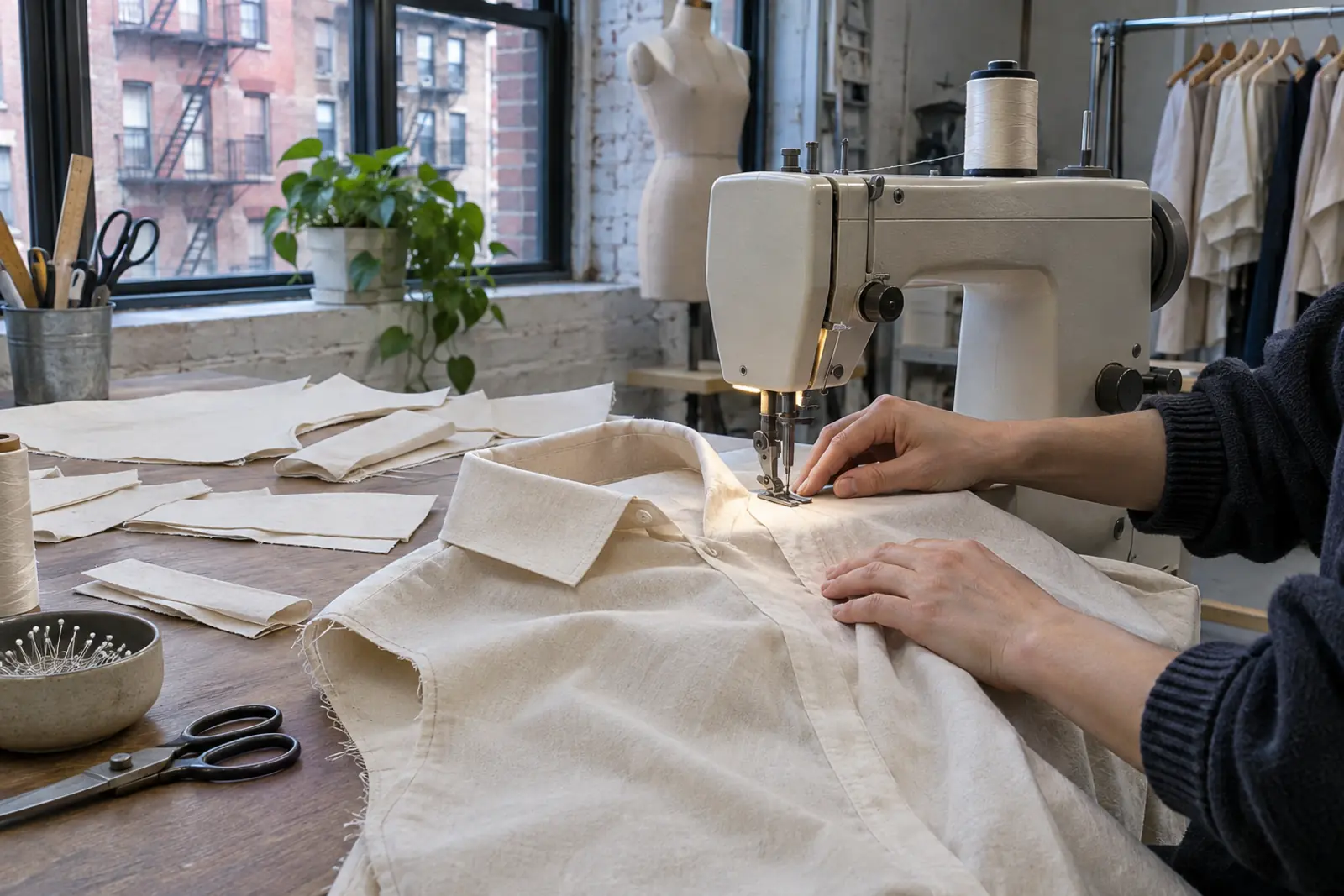
“Made in NYC” can describe clothing designed here, cut and sewn here, finished here, or sampled here before production moves elsewhere. Those are different claims, and a neighborhood name does not explain the difference. To find locally made clothing on the Lower East Side or in Nolita, read the garment label, look for a specific account of production, and ask where each stage happens. A useful answer names the work done in the city. An office location, a studio photograph, or a New York sensibility tells you something else.
One point saves confusion early: federal textile labeling rules deal with the country of origin, not the city, and “Made in USA” has its own rules. Anything more specific about New York comes from the brand, so it is worth checking.
What counts as locally made?
A garment passes through several kinds of work before reaching a hanger: design, patternmaking, sampling, cutting, sewing, finishing, and inspection. A label may keep some stages close to its studio and send others elsewhere. Fabric and trims have their own origins, separate from where the garment takes shape.
Specific descriptions make comparison easier. “Cut and sewn in New York City” explains more than “New York label.” Neither phrase, by itself, tells you where the fabric was woven or knitted. Decide which part of local production matters to you, then ask about that part.
| Claim on the label or website | What it may mean | What to ask |
|---|---|---|
| Designed in NYC | Creative work happens here; manufacturing may happen elsewhere. | Where are the garments cut and sewn? |
| Made in NYC | The statement suggests local production but leaves the stages unexplained. | Which production stages take place within the city? |
| Finished in NYC | Local work may include pressing, embellishment, or final assembly. | What arrives unfinished, and what work happens here? |
| Sampled in NYC | Development garments are made here; the selling stock may be produced elsewhere. | Where was this particular garment produced? |
| New York label | The business identifies with the city. | Does that describe the business location, production, or both? |
Read the label, then ask about the gaps
FTC guidance under the Textile and Wool Acts says textile labels must identify fiber content, country of origin, and the manufacturer, importer, or other firm handling the product by company name or RN. An RN is an optional alternative to the name, not an extra requirement. The FTC’s textile labeling guidance explains those requirements.
A country-of-origin statement does not identify a city or workshop. An RN identifies a business; it does not certify local manufacturing. “Made in USA” has a federal standard, so treat it as a regulated claim rather than a loose expression of style.
Questions worth asking
- Where were this garment’s fabric cutting and sewing done?
- Was only the sample made locally, or was the selling stock made here too?
- Does the production description apply to this piece or only to part of the collection?
- What finishing work happens in the city?
Ask about the item in your hand. Production arrangements can differ across garments, and a general website statement may leave those differences unexplained. For secondhand pieces, the guide to reading and dating older clothing labels helps separate historical clues from present-day assumptions.
Is made in NYC the same as made in USA?
No. A garment sewn in New York is made in the United States, but “Made in USA” on its own is a stricter claim than “sewn in NYC.” Under FTC textile guidance, an unqualified “Made in U.S.A.” label is allowed only when the product is made completely in the U.S.
What a New York-sewn garment made from imported fabric must say instead:
- Imported fabric, U.S. sewing: a single statement such as “Made in U.S.A. of imported fabric,” according to the FTC.
- Work split between countries: the label must identify both, for example “Made in Sri Lanka, finished in U.S.A.” (the FTC’s own example).
- Imported goods: the label must name the specific country where the product was processed or manufactured; a region such as the European Union is not enough.
The FTC’s Made in USA standard says a product making an unqualified claim should contain “no — or negligible — foreign content.” A qualified claim, such as a stated percentage of U.S. content, is meant for products that fall short of that. These rules cover the country. They do not define what a brand may mean by a city, which is why the questions above still matter.
How to find locally made clothing in NYC
Start with the label, then the brand’s own description of its production, then a direct question. A step-by-step approach:
- Check the origin line on the label. “Made in U.S.A. of imported fabric” is a different statement from a bare “Made in U.S.A.”
- Read the brand’s production page. Look for named stages (cut, sewn, finished) and a city, not general phrases such as “crafted in New York.”
- Ask whether the claim covers the item you are holding or only the sample or one capsule collection.
- Ask where the fabric and trims come from, since local sewing does not establish local materials.
- Prefer an answer you can put in writing. A brand that manufactures locally can usually say so plainly.
Where to look in person: the Lower East Side and Nolita both have independent boutiques where small labels sell directly, and the walking route in the Orchard Street to Mulberry Street fashion walk passes several of those shop types. The Lower East Side shopping guide and the Nolita shopping guide explain what each area sells. For older pieces that were produced when the neighborhood was still a garment center, see vintage shopping on the Lower East Side.
For brand names, there is no single official list of New York-made labels, and a list would go stale: brands change factories and sometimes move production out of the city. The CFDA’s Fashion Manufacturing Initiative lists a Production Directory among its programs; that is a place to look for how local production is organized, but this guide could not confirm that it works as a shopper’s brand list.
The Garment District behind the clothing
NYCEDC’s Midtown Made page puts about 1,000 fashion businesses in the Garment District and lists a Local Production Fund among its programs. The district remains a center of local production, even when the finished clothing reaches a shopper downtown. A label’s retail setting and its production setting need not share a neighborhood.
Local manufacturing also depends on work less visible than a finished jacket: patterns, samples, cutting, sewing, and finishing. Proximity can make fittings and production discussions easier, though it does not guarantee quality. The Lower East Side garment-trade history explains the neighborhood’s earlier relationship with clothing production.
Support for local production
The CFDA’s Fashion Manufacturing Initiative, working with NYCEDC, launched in 2013 at industry request, according to the CFDA. The CFDA says it expanded in October 2019 into a $14 million public-private partnership with four initiatives: the FMI Grant Fund, the Local Production Fund, the Workforce Relief Collective, and the Production Directory. A CFDA and NYCEDC announcement in April 2026 described a new Local Production Fund with a combined $1.7 million investment. These efforts support local manufacturing capacity; their existence does not establish how any particular garment was made.
Verify with NYCEDC’s Midtown Made page for current program information and availability. Do not assume a program is accepting applications because an announcement remains online.
Shopping, price, and keeping the piece wearable
Small runs can spread development work across fewer garments. Local labor, repeated fittings, and complicated construction can also raise costs. Those are reasons a locally produced piece may cost more, not proof that every higher price reflects better work. Inspect seams, closures, lining, and fit with the same attention you would give any clothing.
Look for direct sales from small labels, studio sales, and sample sales where production questions can accompany the purchase. A studio setting does not establish where manufacturing happened. The sample-sales guide explains what to check when development pieces and selling stock appear together.
Before paying
- Read care instructions and consider whether the routine suits your life.
- Ask about repairs, replacement fastenings, and any likely alteration difficulties.
- Check the refund policy, especially for samples or discounted pieces.
- Ask for a written quote for alterations or repair; prices vary.
Keep the care information and purchase record. Follow the garment’s instructions, deal with loose fastenings promptly, and ask a suitable cleaner about unfamiliar materials before experimenting. Local origin does not make a fabric washable. For checkout questions, consult the guide to NYC clothing sales tax and verify current treatment with the New York State Department of Taxation and Finance. This is general information, not legal or tax advice.
Frequently Asked Questions
Does designed in NYC mean made in NYC?
No. Design describes the development of the garment’s appearance and structure. Cutting, sewing, and finishing may happen elsewhere. Ask where the particular garment was produced, rather than relying on the location of the design studio or the business.
Does an RN prove that clothing was made locally?
No. Under FTC guidance, an RN can appear instead of a company name on a textile label. It identifies a business handling the product. It does not identify a sewing location or establish that production happened in New York City.
Is locally made clothing always better quality?
Local production alone does not establish quality. Examine the fabric, seams, closures, and fit, and ask how the garment should be maintained. A clear account of production is useful information, but the piece still needs to work on your body and in your wardrobe.
Can a sample be made locally while the collection is made elsewhere?
Yes. Sampling and production can happen in different places. A locally made development garment does not establish the origin of the selling stock. Ask whether the production description applies to the sample, the finished collection, or the individual piece being offered.
Can a garment sewn in New York say Made in USA if the fabric is imported?
Not as a plain “Made in U.S.A.” According to the FTC, a U.S.-made textile product that uses imported material must say so in one statement, such as “Made in U.S.A. of imported fabric.” An unqualified claim is reserved for products made completely in the U.S.
Is there an official list of made in NYC clothing brands?
None that this guide could confirm. The CFDA’s Fashion Manufacturing Initiative lists a Production Directory among its programs, but this guide could not confirm that it works as a shopper’s brand guide. For a shopper, the dependable method is to ask the brand where the specific item was cut and sewn.