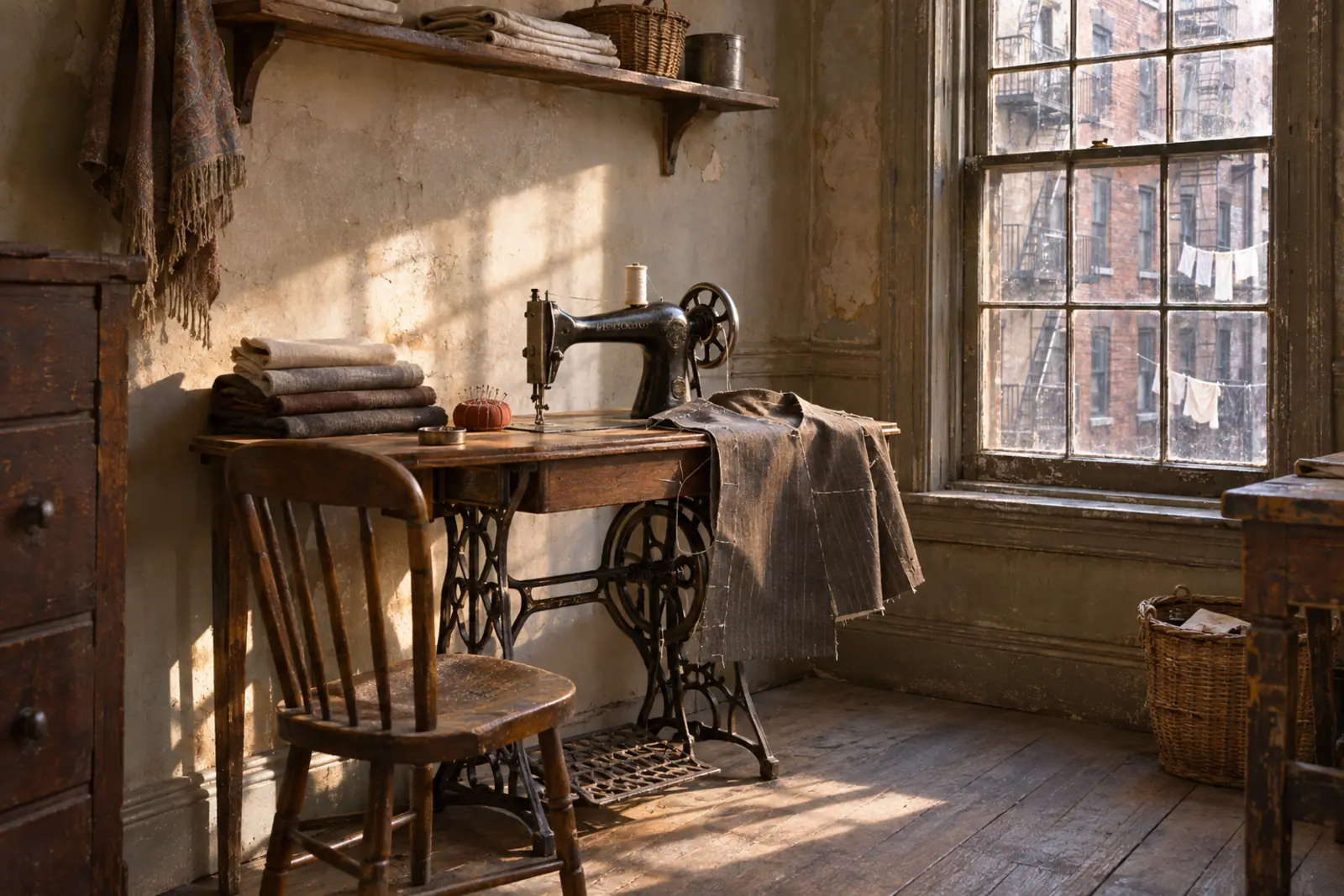
Lower East Side garment history starts with nineteenth-century immigrant arrivals who brought sewing skills and needed to earn a living close to home. Tenement apartments doubled as workrooms, piece-work connected households to manufacturers, and Orchard Street and nearby streets joined making clothes to selling them. The trade then became a center of labor organizing: the 1909 shirtwaist strike, the 1910 cloakmakers’ strike and, after the 1911 Triangle fire, a push for safer workplaces. Today a few long-standing clothing and fabric stores remain alongside newer boutiques, though the old concentration of sewing and selling has changed.
How clothing work filled the neighborhood
Garment work could begin with a sewing machine, hand tools and a connection to someone supplying work. It did not necessarily require a separate factory floor. Apartments served as places to live, cut, sew, finish and bundle garments, with household routines fitted around production. The same room could carry several jobs, none of them comfortably.
What piece-work meant
Piece-work paid for completed work rather than simply for time spent working. A worker’s earnings therefore depended on the rate offered, the work available and how much could be finished. Speed mattered. So did interruptions, difficult fabric and the possibility that completed work would be rejected. A pile of garments represented income still to be earned.
- Making: cutting, sewing and finishing could be divided among different workers.
- Home work: domestic space became production space, with little separation between household life and earning money.
- Selling: clothing merchants connected the neighborhood’s manufacturing activity to shoppers looking for useful goods at manageable prices.
Orchard Street’s identity as a bargain street grew within this wider clothing economy. Sewing and retail belonged to the same neighborhood, but they were different kinds of work. A low selling price tells little about the labor behind a garment. For the present-day street pattern, the Lower East Side shopping guide explains how to approach the area without treating every storefront as a surviving workshop.
Organizing the people who made the clothes
Work spread across apartments and factories could leave individual workers with little influence over rates or conditions. Union organizing sought to turn separate complaints into collective demands. According to the Kheel Center’s ILGWU timeline, the International Ladies’ Garment Workers’ Union formed on June 3, 1900, bringing together members from several garment-making cities.
The 1909 shirtwaist strike
The 1909 shirtwaist strike, known as the “Uprising of 20,000,” began after officers of Local 25 proposed a general strike in the garment sector. The Kheel Center records that on November 22, 1909, Clara Lemlich called for the general strike at Cooper Union. It lasted 13 weeks and ended with a contract raising wages for 15,000 workers, according to that same timeline. Those results made organizing tangible: a collective refusal to work could change what workers received for their labor.
The strike belongs to the history of the city’s garment workforce, rather than to a single shopping street. It is useful background when looking at old clothing, too. A union label can carry evidence about organized production, although it cannot tell the whole story of a garment’s working conditions. The guide to dating vintage clothing labels explains how to read such clues cautiously.
The 1910 cloakmakers’ strike and the Protocol of Peace
The next year, according to the same timeline, New York cloakmakers went on strike in what became known as “The Great Revolt.” Louis Brandeis helped develop the “Protocol of Peace” between the ILGWU and the Manufacturers’ Protective Association. The Protocol became a landmark attempt to settle disputes between workers and manufacturers by agreement.
The Triangle fire: keep the geography straight
According to the Kheel Center, the Triangle Shirtwaist Factory fire on March 25, 1911, killed 146 garment workers. Cornell’s Triangle fire site says the fire started near closing time and that within 18 minutes 146 people were dead. The factory occupied upper floors of a building in Greenwich Village, not on the Lower East Side. Its place in garment history connects it to this neighborhood; its actual location should not disappear in the telling.
Some of the workers who died were Local 25 members who had taken part in the 1909 strike, according to the ILGWU timeline. The fire became a turning point for workplace safety. The Kheel Center timeline calls it a catalyst for unionization and public support for occupational health and safety standards. It exposed the distance between producing clothing efficiently and protecting the people doing the work. When reading neighborhood histories, keep both the shared industry and the separate locations in view.
A short timeline
| Year | Event | Source |
|---|---|---|
| 1900 | ILGWU formed on June 3. | Kheel Center ILGWU timeline |
| 1909 | The Uprising of 20,000 began. | Kheel Center ILGWU timeline |
| 1911 | The Triangle Shirtwaist Factory fire occurred on March 25. | Kheel Center ILGWU timeline |
| 1988 | The Tenement Museum was founded. | Tenement Museum public history |
| 1994 | The restored Orchard Street tenement became a National Historic Landmark. | National Park Service landmark records, as summarized in public histories of the museum |
| 1998 | The Lower East Side Tenement Museum National Historic Site was authorized by Congress. | Act of Congress, 1998 |
The table leaves out two labor dates from the same source: the November 22, 1909 Cooper Union call for the general strike, and the 1910 cloakmakers’ “Great Revolt” that produced the Protocol of Peace. The Kheel Center’s ILGWU timeline supplies a fuller labor chronology. Museum designation dates describe preservation and public interpretation, rather than the beginning or end of garment work on the street.
Where production went, and what remains
Production shifted uptown to the Garment District and later overseas. Manufacturing, selling and designing no longer needed to occupy the same neighborhood. The CFDA describes the industry’s workforce as having declined substantially over time. That broad change helps explain why a street can retain its clothing associations while supporting much less clothing production.
A few long-standing clothing and fabric stores sit alongside newer boutiques. Their presence does not make the neighborhood a preserved factory district. Nor does a local retail location establish where an item was sewn. The page on locally made clothing labels explains the questions to ask about production.
Orchard Street has historically closed to cars on Sundays as part of its bargain-shopping identity. Verify with the Lower East Side Business Improvement District before planning around that arrangement; a historical description is not a current street-access notice.
Seeing domestic space as working space
The Tenement Museum’s restored apartments and shops make the overlap between home and work easier to understand. The museum was founded in 1988; the National Park Service lists the site as the Lower East Side Tenement Museum National Historic Site and says the museum tells the stories of working-class tenement residents who moved to New York City from other countries and other parts of the country. Entry is by guided tour; reserve tours at tenement.org. Verify current tour arrangements with the museum, and check the National Park Service’s site overview for its designation and affiliation.
For a way to connect this history to the streets as they look now, the self-guided walk from Orchard Street to Mulberry Street follows the area on foot, and the guide to vintage shopping on the Lower East Side shows how older garments and labels turn up in today’s shops.
Frequently Asked Questions
Why did garment work happen in tenement apartments?
Home-based sewing allowed production to take place without a separate workshop. Manufacturers could distribute work among households, while workers fitted paid tasks into domestic space. Piece-work tied earnings to completed output, making the apartment both a home and a workplace.
What was the 1909 shirtwaist strike?
It was a general strike of New York garment workers, called the “Uprising of 20,000.” Clara Lemlich called for it at Cooper Union on November 22, 1909. It lasted 13 weeks and ended with a contract raising wages for 15,000 workers, according to the Kheel Center.
What was the Great Revolt of 1910?
It was the cloakmakers’ strike in New York City. It led to the “Protocol of Peace” between the ILGWU and the Manufacturers’ Protective Association, according to the Kheel Center.
Was the Triangle Shirtwaist Factory on the Lower East Side?
No. It occupied upper floors of a building in Greenwich Village. The fire belongs in Lower East Side garment history because of the connected workforce and industry, but the factory’s location was elsewhere.
Can an old union label explain a garment’s history?
It can provide evidence about organized production and help with dating when considered alongside construction, fabric and other labels. It cannot establish every working condition, identify every person involved or prove that the garment was made on the Lower East Side.
Can visitors enter the museum’s restored spaces independently?
Entry is by guided tour, so arrange a reservation through the Tenement Museum’s website. Check the museum’s current descriptions before choosing: the restored apartments and shops are interpreted spaces, and access depends on the tour offered.