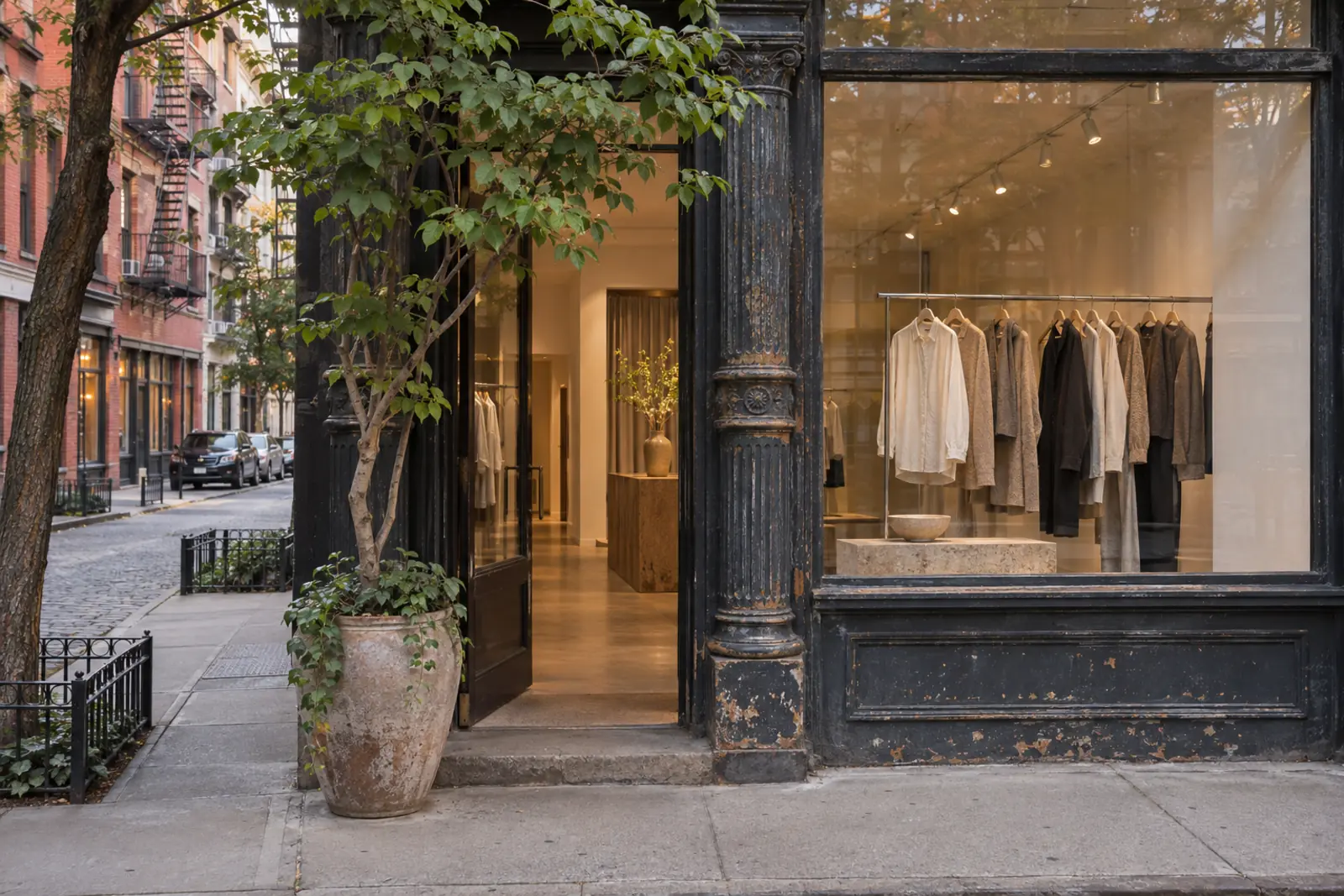
Nolita is short for North of Little Italy: a compact Manhattan shopping area associated with small boutiques and narrow streets, roughly between Houston Street and Broome Street and between the Bowery and Lafayette Street. It is a neighborhood nickname, not a legal district, and it has no official borders. Sources differ on the southern edge, which is placed at Broome or at Kenmare Street. For a shopper, the useful definition is simpler: short stretches of Elizabeth, Mott and Mulberry streets, connected by cross streets where a small storefront can warrant a closer look.
Where is Nolita and what are its boundaries?
Nolita sits in Lower Manhattan. Common descriptions put Houston Street to the north, the Bowery to the east, Lafayette Street to the west and Broome Street roughly to the south. On a map it lies east of SoHo, south of NoHo, west of the Lower East Side and north of Little Italy and Chinatown.
Because the borders are informal, two maps can draw them a block apart. Use the street location to plan your walk; treat the neighborhood label as an approximate description.
What does the name Nolita mean?
The name is a contraction of "Northern Little Italy". According to the Wikipedia article on the neighborhood, a New York Times article of May 5, 1996 debated several names for the newly fashionable area, and Nolita is the one that stuck. The same article describes an influx of young professionals in the second half of the 1990s, with new boutiques, restaurants and bars, and notes that rising rents have since eroded much of the area's former Italian character.
What the neighborhood feels like on foot
Nolita works at the scale of a few small blocks. Elizabeth, Mott and Mulberry give a walk its north-south structure; Prince, Spring and Kenmare provide crossings and opportunities to change direction. The streets are narrow enough that window displays across the road can distract from the window directly ahead. Look before crossing anyway.
The compact layout makes browsing easy to improvise. It does not mean every doorway contains a shop, or that every shop welcomes the same kind of browsing. Residential entrances, commercial spaces and appointment-based businesses can sit close together. Read the door before trying the handle.
Names become less useful near the edges. A listing might describe a location as Nolita, Little Italy or SoHo depending on its purpose. Cafés and restaurants fill many ground floors alongside the shops, so a block that looks empty of clothing may still be worth a detour for a break between stops.
What kinds of shops to expect in Nolita
The shopping character centers on smaller premises and relatively focused selections. Small boutiques, designer showrooms adapted for retail, accessories and beauty businesses belong to the area's general mix, alongside some vintage and consignment shopping. That describes shop types, not a promise about the present occupants of any particular block.
Small boutiques and showroom-style spaces
A compact shop may carry a tightly edited range rather than a broad run of sizes, colors and categories. A showroom-style space may display garments more sparsely, with additional pieces available to ask about. Neither arrangement tells you what is actually available for purchase or how quickly an order could arrive.
Ask whether the piece on display is sale stock, a sample or an example for ordering. Then ask about available sizes, delivery arrangements and the terms attached to an order. A beautiful rail is not an inventory system. If you are hoping for reduced prices, the guide to how NYC sample sales work explains what a sample sale is and how it differs from an ordinary markdown.
Accessories, beauty and secondhand clothing
Accessories and beauty can fit naturally into a short browsing stop, but check practical details before paying: dimensions, materials, care requirements and restrictions on returns after opening or use. For anything intended as a gift, ask how an exchange would work.
For vintage and consignment, examine the actual garment rather than relying on the category. Look at seams, closures, linings and areas of wear. The guide to thrift, consignment and resale explains why those terms describe different selling arrangements rather than a shared standard of condition. For a closer look at judging a piece, see the guide to vintage shopping on the Lower East Side.
Nolita, the Lower East Side and SoHo
These areas connect easily on a map, but their shopping rhythms differ. Nolita favors short blocks and smaller spaces. SoHo to the west has more of the larger chain-store format. The Lower East Side offers a broader street-by-street mix, where fashion browsing shares the walk with other kinds of neighborhood commerce.
| Area | General shopping character | Useful browsing approach |
|---|---|---|
| Nolita | Small boutiques, showroom-style retail, accessories and beauty, with some secondhand clothing | Browse short stretches and ask about stock beyond the display |
| Lower East Side | A varied mix of fashion spaces, vintage and other neighborhood businesses | Choose streets around your interests and allow for gaps between stops |
| SoHo | Larger chain stores and more expansive retail spaces alongside smaller shops | Identify the kinds of stores you want before covering more ground |
These are broad distinctions, not rules for every storefront. The Lower East Side shopping guide explains how its streets and shop types fit together if that is where you want to spend more of your day.
Planning a walk and getting there
When to go
Choose a day when you have room to browse without needing every stop to succeed. Small shops can keep individual schedules, and a showroom may require an appointment. Check directly before making a special trip, particularly if you need a fitting, an order consultation or a particular item.
If quiet browsing matters, ask the business when it tends to be less crowded. If daylight matters for inspecting color or fabric, build that into your plans. Do not assume neighboring shops share their hours, or that an online listing has caught up with a changed schedule.
Subway access and a connected route
Nearby subway options include Spring St, Bleecker St, Prince St and Broadway-Lafayette. Houston Street and the Canal Street stations are also within reach of the edges of the area. Choose the station that suits your starting point and the direction of your walk. Check station names carefully when planning the journey, since the street name alone may not tell you which service you need.
Verify with the MTA for current service changes and station information; the MTA line map is an official starting point for checking the Lexington Avenue approach.
The self-guided fashion walk through Nolita and the Lower East Side connects the areas without making shopping depend on a fixed roster of businesses. Leave space to stop, double back or skip a block. A walking route should survive an uninteresting window.
What to ask before buying
A small space can make questions feel conspicuous. Ask them anyway. Clear answers matter more than an agreeable atmosphere, especially when a purchase involves an order or alterations.
- Is this garment available to take away, or does it need to be ordered?
- What are the fabric composition and care requirements?
- Are there condition issues, repairs or alterations to disclose?
- What is the return or exchange policy for this purchase? The guide to store refund policy rules in New York City explains what shoppers can generally expect.
- If work is promised, can the scope, price and completion arrangements be put in writing? See the tailoring and alterations guide for what to ask a tailor.
Frequently Asked Questions
What is Nolita?
Nolita is a Manhattan neighborhood name short for North of Little Italy, or Northern Little Italy. It is known for small boutiques, cafés and narrow streets, and new boutiques, restaurants and bars arrived in the late 1990s. It is an informal label, not an official district.
Does Nolita have official boundaries?
No. Nolita is a neighborhood nickname rather than a legal district. Descriptions commonly use Houston, Lafayette and the Bowery as reference points, while the southern edge varies between Broome and Kenmare. For planning purposes, follow the actual street location rather than insisting on a precise border.
Is Nolita the same as SoHo?
They are neighboring shopping areas with different general characters. Nolita lies east of SoHo and is associated with compact boutiques and narrow streets; SoHo to the west includes larger chain stores and more expansive retail spaces. The transition is gradual, and individual storefronts can depart from either description.
Can you browse without an appointment?
Check the particular business. A conventional retail space and a showroom can have different arrangements, even when their windows look equally inviting. If a visit depends on seeing a particular garment or discussing an order, confirm availability and access before setting out.
Is Nolita useful for vintage shopping?
Vintage and consignment are part of the area's general shopping mix, but they do not define every block. Treat a secondhand garment as an individual inspection: assess condition, fit and evidence of repairs, and ask what the seller can actually establish about its age.